.png)

We need more bridges and more patient capital for climate infrastructure, but I am optimistic: the conversation is changing - Sorina Uleia, Recycllux
Sorina Uleia is the Founder & CEO of Recycllux, a cleantech startup that helps eliminate marine plastic. Since our first interview with Sorina, in May 2025, Sorina was selected among the six semi-finalists for the European Prize for Women Innovators in the EIT Women Leadership category, and received the AI + Climate Award at the She Shapes AI Global Awards. Recycllux was selected for Women TechEU and EPIC-X, two European programmes designed to support and accelerate women-led deep-tech companies.
“Those were personally meaningful because ocean innovation is still not represented as strongly as it should be in mainstream climate and technology conversations.” she adds.
Recycllux also received the Positive Futures Award through ERSTE Foundation’s Marc Impact Programme and were named among the Next Impact Europe 50 Startups to Watch.
Furthermore, the startup has evolved towards a new approach, where they place coastal municipalities and regional authorities, instead of corporates, at the center of their business model.
This pivot has come from listening to the market very closely and understanding that this is where their technology creates the most lasting value.
“Private companies remain essential participants, contributing local capacity and, where appropriate, stewardship funding, but the coastal municipality becomes the anchor around which the local system should organise.
Our early work with private companies was very important to validate the full operational chain - from identifying pollution to organising an intervention and producing verifiable evidence of what happened. Without that phase, I don't think we would have understood the problem deeply enough.
But the more time we spent in the market, the more obvious something became: coastal municipalities and regional authorities face the economic consequences of coastline degradation while carrying day-to-day responsibility for protecting and managing the coastline. When there is pollution, they have to respond. They manage public spaces, contractors and local stakeholders, they have environmental obligations, and increasingly they need data to optimize how resources are deployed.
There is also a strong economic dimension. For coastal communities, the quality of the coastline is part of the local economy. A polluted or neglected beach or waterfront does not affect biodiversity alone; it affects the experience and perception of the destination. Visitors can choose another beach, another town or another region, while local accommodation providers, restaurants, small businesses and tourism services bear the consequences. For municipalities, keeping coastal and public spaces clean, attractive and well managed is therefore not only an environmental obligation, but also an investment in tourism competitiveness, place identity and local economic resilience.
So the question changed from “Who wants to fund a cleanup?” to “Who has the economic interest to keep this coastline clean, attractive and well managed?”
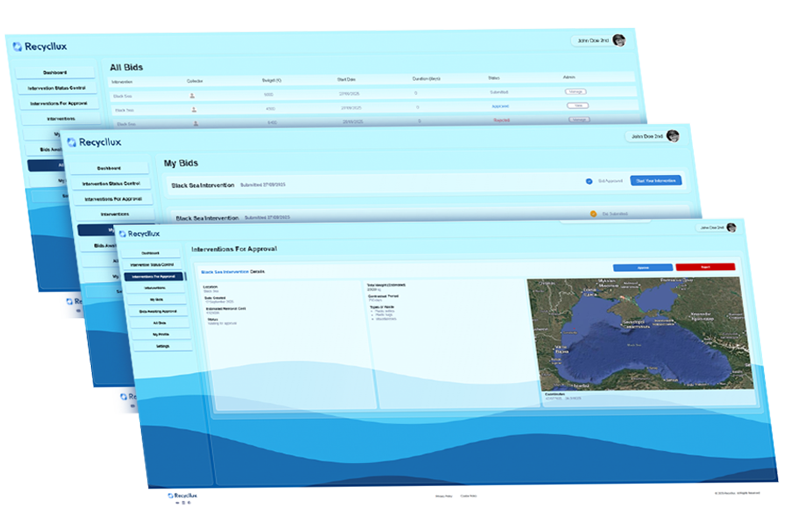
They have already started a first pilot project, with the Municipality of Genoa, after being accepted into the Impact Deal Programme.
“That was where we met Almawave, part of the Almaviva Group. As we worked together, we realised quite quickly that there was a strong alignment between what they were already doing around data, digitalisation and public-sector solutions in Italy, and what we were building around coastal intelligence and marine pollution management.
From there, the relationship developed very naturally. Almawave/Almaviva has strong connections with public administrations in Italy, and they introduced us to the Municipality of Genoa.
What encouraged me most was how open Genoa was to exploring the solution and how quickly we advanced to a Proof of Concept. But I want to be careful not to overstate where we are. This is still a PoC, not a completed city-wide deployment, and we still have some stages to complete.
However, the most important result is institutional validation. We now have them actively exploring the system with us, a strong strategic partner in Almawave/Almaviva, and a clear go-to-market pathway.”
When it comes to measuring success, Sorina says that they look at multiple KPIs. It’s not just about how many kilograms of polluting plastic they help collect - there’s a multi-layered approach, and recently, impact on hospitality has been added to the mix.
“There is the technology layer: detection quality, confidence levels, false positives, and how accurately we can identify and prioritise potential pollution areas. Then there is the operational layer: which areas are prioritised, how quickly we can move from insight to action, which local actors participate, what interventions take place, and what material is recovered.
Beyond that, we are increasingly looking at a much broader impact picture, the CO₂ impact of the interventions, the ecological sensitivity as well as the social dimension: participation, local income creation, and how much value stays within the coastal community.
And, over time, we also want to strengthen the business and economic perspective: what cleaner coastlines mean for tourism, local businesses, destination reputation, and potentially avoided costs for municipalities.
Hospitality came into the picture when we started looking at the problem from the municipality's perspective. For a tourism-dependent city, a polluted coastline is not simply an environmental issue. It can affect the attractiveness of the destination, local businesses, public-space management, and reputation. Coastal tourism is also the largest sector of the European blue economy, so environmental quality and local economic resilience are closely connected. That led us to think about hotels, restaurants, beach operators and other tourism businesses not simply as beneficiaries of a clean coastline, but equally as participants in protecting it. We are now exploring a stewardship model where businesses that economically benefit from a healthy destination can contribute financially to maintaining that natural asset.”
For Recycllux, it’s not just the business model that has changed - but also the team structure. There are now 3 full-time co-founders and have employees and contractors across 7 countries. The three co-founders, Sorina explains, complement well each other because they come with different expertise and focus.
.png)
“My focus is mainly on strategy, partnerships, municipal business development and fundraising.
Alin brings product and technical development coordination, while Marilou brings deep blue-economy knowledge, community networks and stakeholder activation. We each look at the company from a different angle, and that helps us make better decisions together.
They do not need to think exactly like me. In fact, I think it would be dangerous if they did. I look for people who are very good at things I am not, who bring a different perspective and are comfortable challenging assumptions.
I value curiosity, integrity, reliability and the ability to disagree constructively without making disagreement personal. For me, a strong team is one where people can have diverging opinions but still stay aligned around the same purpose.
One of my own lessons as a founder was that, especially in the early years, I tried to carry too much myself. Things move faster when you bring strong people in, trust them and give them real ownership of decisions.
So, choosing people is certainly about competence, but increasingly, for me, it is also about trust: trusting their judgement and their intentions.”
Because they work mostly remotely, Sorina says that this forces you to become much more intentional about clarity. Alignment doesn’t come from endless meetings, she adds - sometimes this can just be a sign that things are not clear enough.
“What I try to create instead is a structure for people to understand the priorities, know what they own, and make decisions independently. This is also part of my own evolution as a leader: learning to enable other people to do things well without me.
Because we are very multidisciplinary, communication matters enormously. We do not all look at the same issue from the same perspective, so a big part of my role is making sure that everyone is solving the same problem and understands how their work connects with the bigger picture.
And then there is the human part. We also try to protect the relationships behind the work, because people need to feel that they belong to something together. One thing that helps us a lot is meeting in person whenever we can. We often use conferences, programmes and industry events as opportunities to spend time together, work side by side and reconnect outside of calls.”
Recycllux is also looking to raise investment - they are targeting a EUR 1 million seed round, with the capital planned to be used to accelerate municipal market access, strengthen delivery capacity and support customer adoption
“There have been challenges. We are building an impact and blue-economy company from Romania, where this investment category is underrepresented. That means we had to work harder to build visibility and connect with the right international investors.
We are using the programmes, awards and European networks to strengthen our presence across Europe. Personally, I am very intentional about where I pitch. Every opportunity to position Recycllux in the markets and investor ecosystems where we want to build a presence is part of that strategy. Selecting the right investors is about building long-term partnerships for the next stage of Recycllux’s growth.
Timing is increasingly favourable both for Recycllux and for the market we are building in. The Blue Economy is moving beyond policy and research towards a more operational and investable market, while European policy is increasingly pushing implementation towards cities and regions.”
When it comes to product development and scaling, the next phase for the startup is deployment at a larger scale. They have built more than 15 active coastal-authority pathways across the Black Sea and the Mediterranean, and are in the process of converting those into recurring municipal revenue.
“On the product side, we are strengthening the intelligence layer. Through the FIERCE project, we are combining Sentinel satellite data with drone observations so we can improve validation and reduce false positives.
We are also continuing to build the municipal reporting layer and automate more of the workflow. We have filed the patent application, which gives us a stronger foundation around the technology.
What I find exciting is that scaling does not mean building a huge central cleanup organisation. The whole philosophy of Recycllux is almost the opposite. We build the intelligence, coordination and verification layer, while working with local partners and activating existing local capacity. The technology becomes more standardised, while execution remains deeply local. That is what gives the model the potential to scale worldwide, and I think it is also what makes it attractive from a long-term investment perspective.”
Finally, we wanted to know how easy or hard Sorina considers it is for a software cleantech startup to grow and thrive in Europe.
“In ocean and water innovation specifically, I think we are seeing a significant shift. European policy is putting much more emphasis on coastal communities, restoration and the blue economy.
But there is still a gap between innovation and adoption. Europe is very good at financing pilots. But converting a successful pilot into a five-year customer contract is still far from straightforward.
We experience this directly. A municipality may really like your solution and genuinely want to work with you, but its budget may have been approved six months earlier. That can create a delay of six to twelve months or more between interest and procurement.
So, I think we need more bridges: easier innovation procurement for authorities and mechanisms that speed pilot transition to a commercial contract.
I would also like to see more patient capital for climate infrastructure, because some of the most valuable companies will not necessarily look like conventional investment cases in their first years.
But I am optimistic. The conversation in Europe is changing. A few years ago we spent a lot of time explaining why ocean pollution deserves serious technology and investment. Increasingly, the question is becoming, 'How do we deploy solutions like this at scale?' For a founder, that is a much more exciting question to answer.”
Thank you, Sorina Uleia!
Image
Gallery.

Explore
Related posts.

Subscribe to the newsletter!
Stay up to date with the latest news & resources from the impact-driven startup world!

