.png)

Impact startups need more spaces to genuinely connect with other founders from impact-driven projects - Laëtitia Launet Gallas, Llum Social
Laëtitia Launet Gallas is the Founder and CEO of Llum Social, a social impact business that helps NGO manage their resources better and coordinate with other organisations, and vulnerable people access those resources more easily, through an easy-to-use platform and app. Llum acts like a bridge between vulnerability and all the agents of a territory who provide help. For government and research institutions, the use of technology makes it possible to analyse territorial data, always anonymised, around social action.
She is one of the first founders we interviewed for this platform, more than a year ago. Here’s what has happened since:
“First, Llum spent six months in Spain’s first-ranked startup accelerator programme, where we faced uncomfortable–but necessary–questions, rethought every aspect of the project, and started interviewing dozens and dozens of social organisations.
These conversations led us to refine the approach, step by step. Starting as a platform solely focused on homelessness a few years back, Llum Social now includes any area of social action and intervention: from homelessness, to immigration, elder people, families, youth, childhood, HIV/AIDS, mental health, and other situations that involve potential social vulnerability.
In parallel, we decided it was time to open the platform to any non-profit organisation through a freemium option. The decision was clear: economic limitations should not be a barrier for organisations to bring help closer to people who might need it. Economic viability needed to come from other sources: subscription plans for those who would want to go a step further, and bigger projects with specific organisations or territories.
With all of this in mind, and after months of work on the SaaS platform that came after the initial mobile App we had launched in Mallorca in 2024, Llum Social is now active in the Aragón region in Spain, where near ten organisations are already working in network, and we are currently onboarding new organisations in Cantabria, with several other territories and national networks soon to join. In parallel, we're still developing our local solidarity-shops project for homelessness — hopefully with news on that front soon!”
As a solo founder, Laëtitia says that what has helped her the most over the last year was connecting with other founders in the accelerator program.
“Not just networking, but sharing the day-to-day uncertainty, decisions, and doubts on site. That kind of proximity is hard to replicate.
Beyond that, something that consistently works for me is staying immersed in inputs related to the fields: books, podcasts, investigating projects in related sectors but also from different areas. Sure, they rarely give you a straight answer, but I feel they plant seeds that foster reflection.
But the two processes that shaped the project the most were both about listening. First, involving organisations directly: dozens and dozens of interviews that reshaped what Llum Social is today.
And second, keeping a direct feedback loop with the organisations actually using the tool. We run many of our first onboardings as 1:1 sessions to see how organisations really use the platform, and we follow usage data.
And let’s be honest on another resource that kept us moving forward: funding also helped us stay afloat through the redesign and development, from entrepreneurship awards to public and national grants.”
One of the biggest challenges in building Llum, she adds, is developing a solution for a sector that is already overloaded, with limited resources and slow decision-making cycles.
“And validating a new product in a field where technology still raises a lot of distrust, even more so when it comes from a young, early-stage project.
Finding the right formula to reach the first NGOs has been a trial-and-error process: a lot of learning, listening, asking the right questions and trying new approaches. Having worked with the Red Cross early on was a real advantage. It was our first step into the ecosystem, with an amazing team there always ready to share a piece of advice.
The freemium model for NGOs was also key to lowering barriers, not only for adoption, but also because it aligns with our core value: removing barriers so help can reach people. Organisations can use the platform for free, and only pay if they want more advanced features.
Ultimately, to bring new organisations in and get them started, what has been working best is entering through existing networks and coordinators, combined with individual organisations on the ground, going one by one in those first local contacts. We also run group trainings, and we accompany the first organisations very closely with 1:1 onboardings, both to support them through their first steps on the platform and to understand how to make the whole thing easier for everyone who comes next.”
Llum is targeting several categories of stakeholders, and they face different challenges in adopting technology.
“For people in vulnerable situations, the level of comfort with technology varies a lot depending on the group, the situation, the age... There isn't a single reality: for most, a smartphone is already part of their daily life; for others, there's a real digital gap. For the latter, it's often the organisations accompanying them who pass on the information, and the app gives them an easy way to do it. But it's also made for the people around them: a family member, a volunteer, or anyone with the app can look something up and pass it on to the person who needs help.
However, the biggest barrier we see is that the help is scattered across many places, and it's hard to know what's available, and that's even harder when you're going through a vulnerable situation.
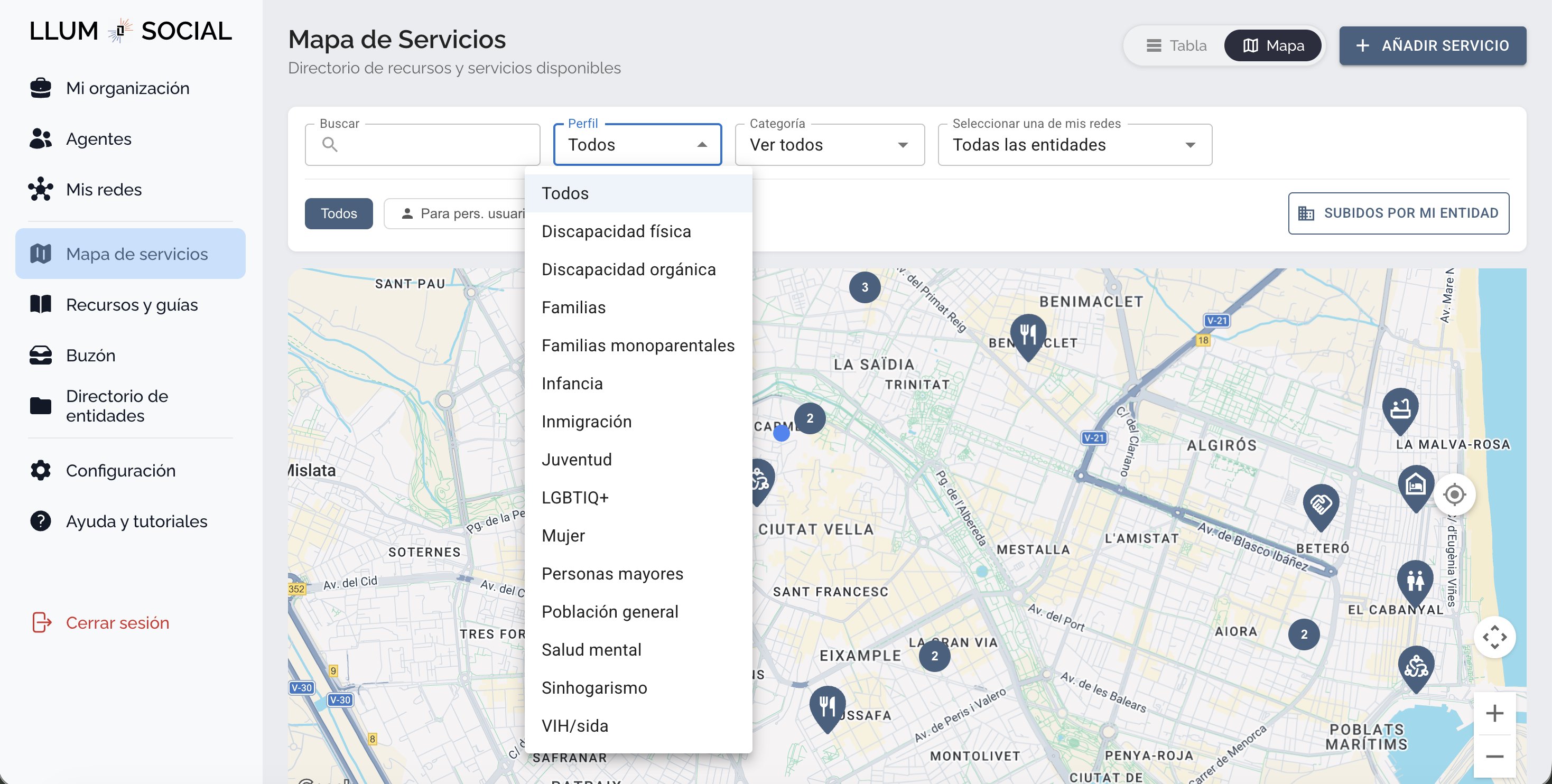
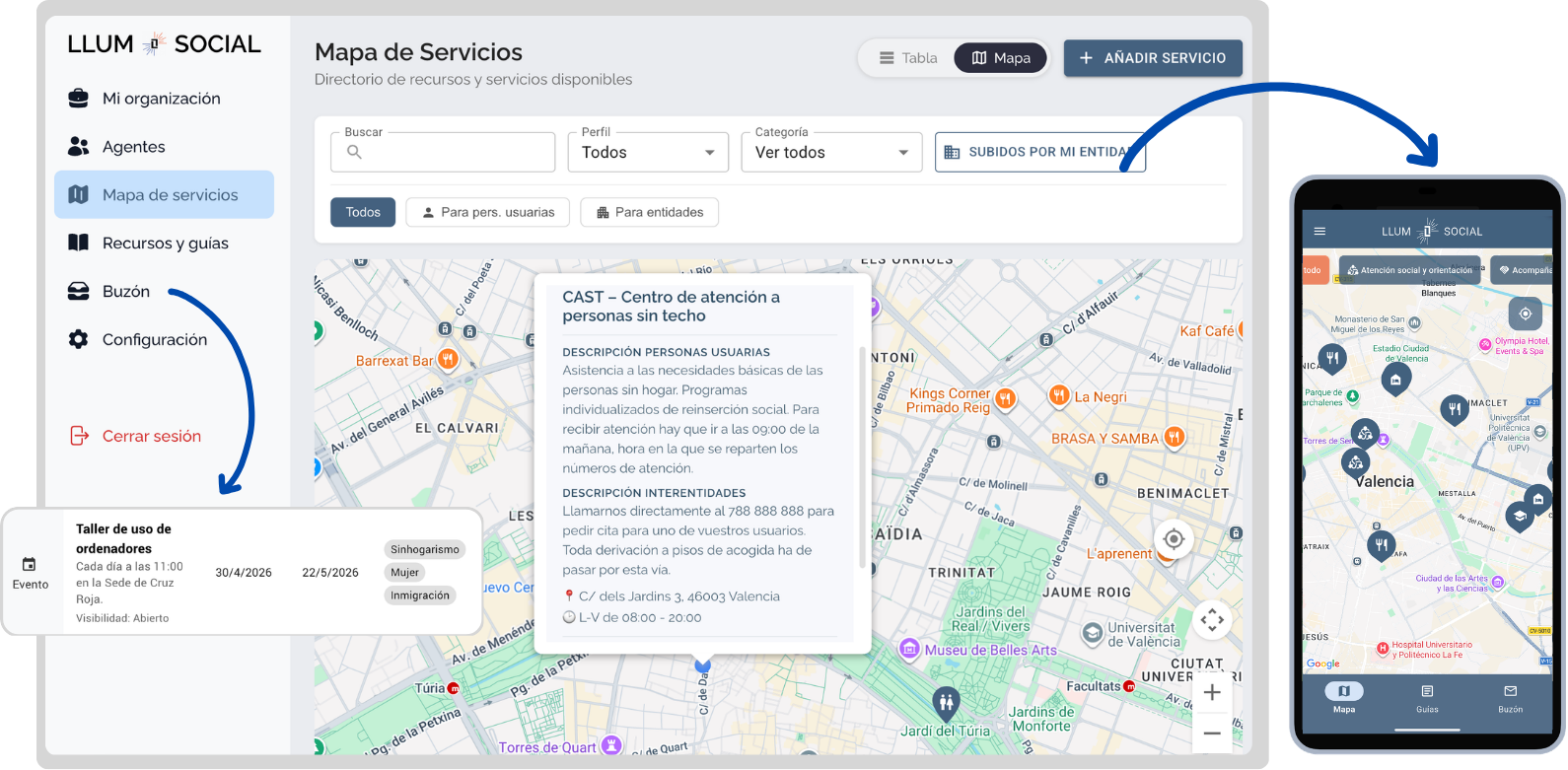
So Llum Social brings it together: a map of the resources in a territory, organised by type and by the situation they're for, and, importantly, available in several languages. In this sense, technology can become a bridge to bring information closer.
For social organisations, the challenge is often a kind of wariness towards technology, and the reluctance to take on a new tool when they already have so much on their plate, and when many have tried other options before that didn't quite work. The way we address this is by keeping it as simple and practical as possible from the very first contact: we usually start with a demo or a short video so they can see for themselves how easy it is, and we back that up with practical tutorials they can follow at their own pace.
We also keep close 1:1 onboardings with some organisations, which lets us see first-hand how they use the platform and keep making it simpler. Everything we learn from the 1:1 onboardings goes straight back into the platform, so getting started becomes easier and easier.”
Over the next year, the goal with Llum is to reach more and more territories and regions across Spain.
“So far this year, we have focused mainly on one, and we are now onboarding social organisations in two additional territories. Little by little, we want to connect every layer of the social action area: local coordinators, individual organisations, organisations operating nationwide, and national coordinators or networks.
By the end of the year, we also want the first public social services to become part of this network, as they also are a key piece in every territory.
Beyond reaching more places, another key milestone is depth: not just being present in more territories, but making each map richer, with far more resources shared in every region. Density is what makes the network truly useful, connecting social organisations and bringing help closer to people, without barriers.
The more organisations join, the more useful it becomes for everyone, so this next year is really about building that critical mass and letting the network effect do its work.”
Finally, to build an impact-focused startup, Laëtitia thinks that there is a real need for more spaces to genuinely connect with other founders from impact-driven projects.
“I’m not talking about networking events only, but the kind of day-to-day proximity you get in an accelerator or coworking space, where you end up sharing the real ups and downs.
Every entrepreneurship programme Llum Social was a part of was amazing and brought great support and insights, yet I feel like I always missed an equivalent built specifically for social-economy projects.
The social impact-driven economy faces very particular challenges: slower acquisition cycles, the constant tension between mission and viability, a sector that’s often wary of change. Navigating these challenges with a community that gets it, and mentors who understand the particularities of building for impact, not just traditional business growth, would add a perspective that's not easy to find.”
Thank you, Laëtitia Launet Gallas!
Image
Gallery.

Explore
Related posts.

Subscribe to the newsletter!
Stay up to date with the latest news & resources from the impact-driven startup world!

