.png)

We never sold "innovation”; we sold three things hoteliers already wanted. - Sabrine Chennaoui, MONSAPO
Sabrine Chennaoui is the Co-founder and CEO of MONSAPO, a Franco-Tunisian company that converts used cooking oil into eco-friendly professional cleaning products used across four zones: laundry, kitchen, housekeeping and spa. They are using automated and monitored machines for collective catering, hotels, restaurant chains, and factories and have, until now successfully proved their potential and impact by signing clients and multiple letters of intent and by obtaining French and international patents on their closed-loop automated saponification process.
The team has built three functional machine prototypes that culminate in an industrialized V2, where a full production cycle delivers 20 liters of finished product in 30 minutes (versus 6 hours on V1). One of their machines replaces an entire cleaning supply chain.
.png)
Sabrine founded MONSAPO after her experience in a hotel in Tunisia. That’s where she saw the problem with her own eyes - hotels were throwing away hundreds of liters of used cooking oil, while at the same time buying industrial quantities of cleaning chemicals in plastic packaging.
“Two flows crossing each other every day without ever meeting: the used oil going out, the detergent coming in. One obvious circular connection.
I started MONSAPO as an ecological cleaning products company. But I quickly realized the real innovation was not selling another green detergent, it was closing the loop on-site. So we pivoted to hardware: SapoCircle, a fully automated, IoT-connected machine that converts a hotel's own used cooking oil into professional-grade detergents, directly on their premises. The kitchen's waste becomes the housekeeping department's supply.
My background is not traditional deeptech (business analyst at Novo Nordisk, communications at Mercy Corps), but that turned out to be an asset: I approach this as a business problem with a technology answer, not the other way around.”
Sabrine and MONSAPO work with the hospitality industry - a conservative one, for good reasons, she says. As operations must run flawlessly around the clock, and guest experience must be maintained at the same standards, selling “innovation” to them was not the right angle. Instead, they sold them something they already needed and wanted:
“Cost reduction. At our reference site, detergent spend dropped from 30,000 to 21,000 EUR per year, with a payback on the machine of under 18 months.
A waste liability solved. Used cooking oil is a compliance and logistics headache, and we turn it into an asset: zero liters discharged.
Zero operational burden. The machine is fully automated, so staff do not become chemists. Half a day of training is enough.
The proof that the pull is real: we did not chase our current pipeline. After our first pilot, hotels came to us. Today we have signed letters of intent from major Tunisian hospitality groups, including a chain operating six hotels. When a hotelier tells another hotelier it works, resistance disappears. Peer validation beats any pitch deck in this industry.“
La Badira is MONSAPO’s reference deployment - a 5-star hotel in Hammamet, where their machine has been working since November 2025.
“The results, measured over a full year of operation: annual detergent spend reduced from 30,000 to 21,000 EUR, 1,800 liters of used cooking oil captured with zero liters discharged, 1.77 million liters of water pollution avoided, and 2 tonnes of CO2 avoided per year. Return on investment: 1.31 years, with a projected net gain of 113,000 EUR over five years.
Beyond the numbers, the operational validation matters most: housekeeping and kitchen staff scored our degreaser and descaler 5/5 in field tests against their usual products.
Their Quality and Hygiene Manager summed it up better than any pitch: they stopped paying twice, once to throw away and once to buy back. And the strongest signal of all: at the end of the pilot, La Badira committed to purchase the machine. The pilot converted into our first sale.”
MONSAPO is backed by Techstars, one of the most well-known startup accelerators, with a portfolio worth +$300 Billion. They joined the 2024 Paris programme, and Sabrine says that 3 lessons stand out for her after participating in the accelerator:
“First, talk to the market before perfecting the product. Techstars pushed us out of the lab and into hotel kitchens, and our entire commercial model (machine leasing plus proprietary capsules plus a SaaS dashboard) came from those conversations, not from a whiteboard.
Second, metrics discipline. We learned to instrument everything. Today every claim we make (savings, CO2, cycle quality) is backed by machine data, which changed how investors and clients
perceive us.
Third, the network compounds. Techstars gave us credibility and doors that a Tunisian hardware startup would have taken years to open alone, from investor introductions to international stages.”
Next on their roadmap is to grow in both Tunisia, their first market, and Europe. MONSAPO positions itself as a European-Tunisian company that chose Tunisia as its first market to prove the model before scaling in France.
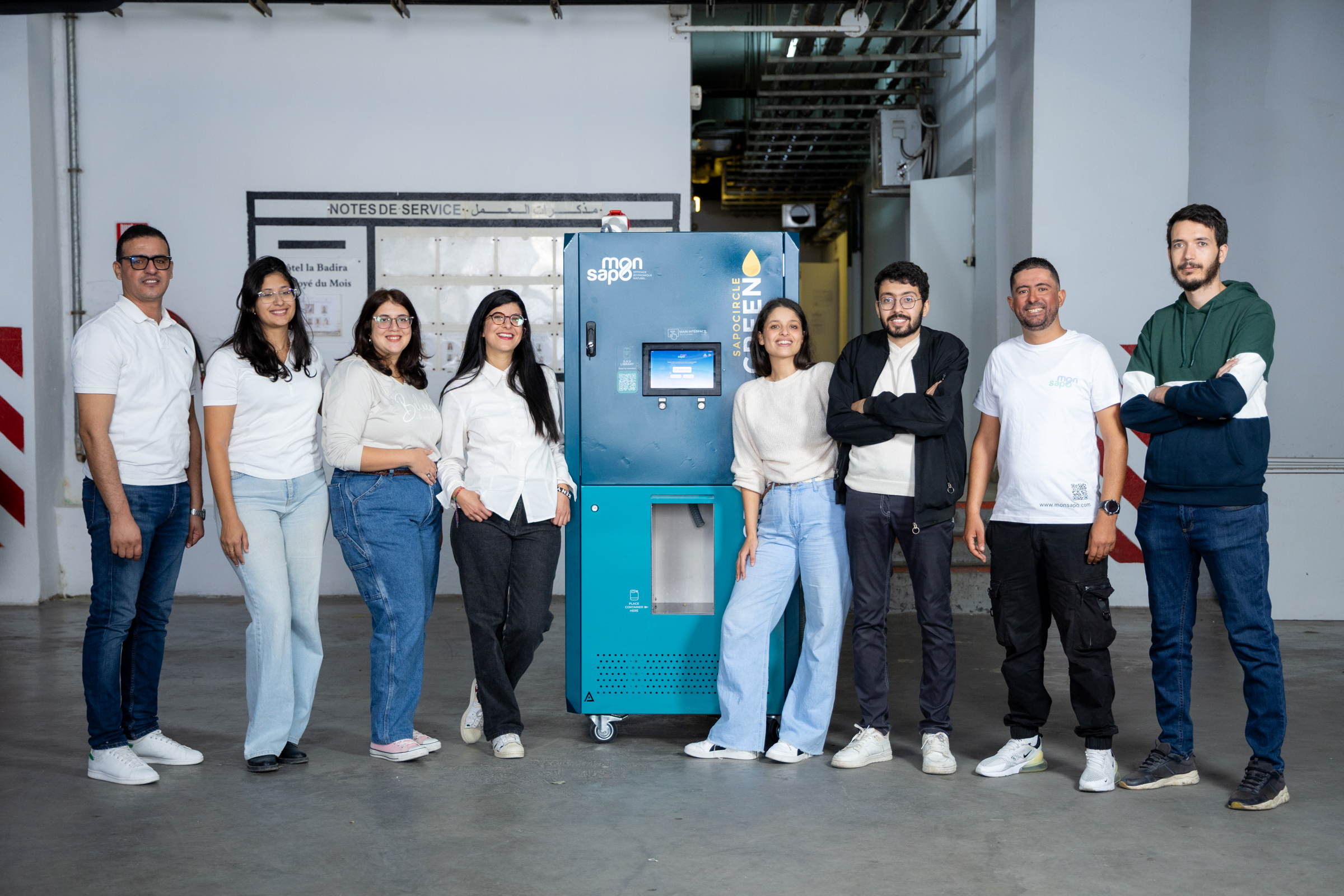
“In 2026-2027 we will deploy our first 50 machines with Tunisian hospitality clients, with series V2 installations starting November 2026. Tunisia is our proving ground, with a dense hotel market, our production base, and fast iteration.
In 2027 we enter France via Marseille, starting with regulatory certification and a first deployment, then commercial scale from 2028. By 2031, we want SapoCircle to be the standard for on-site detergent production in the HORECA sector across Europe and MENA, with industrial-scale manufacturing driving unit costs down.
What we need: we are closing a 1.2M EUR round to fund the first 50-machine deployment and key engineering hires (electrical, embedded firmware, AI for oil analysis and dosing). Beyond capital, we need partners who understand hardware timelines and industrial deeptech, not SaaS metrics applied to machines.”
Lastly, we wanted to know what Sabrine thinks the impact-focused startup ecosystem in Europe needs more of in order to grow:
“Three things. Patient capital for hardware: impact often happens in atoms, not bits. Machines, chemistry and certifications take longer than software, and most funding instruments are not built for that.
Procurement as a growth lever: corporates and public buyers talk about sustainability targets but rarely translate them into purchasing decisions. One signed contract does more for an impact startup than ten awards.
Bridges to the South Mediterranean: startups like ours prove technology in Tunisia faster and cheaper, then scale into Europe. The ecosystems that build these corridors, as Techstars did for us, will capture innovation the others miss.”
Thank you, Sabrine Chennaoui!
Image
Gallery.

Explore
Related posts.

Subscribe to the newsletter!
Stay up to date with the latest news & resources from the impact-driven startup world!

